Human-centered collection
Observe or instrument the human hand
Egocentric video captures visual behavior. Wearable gloves and exoskeletons approximate motion, but they often miss the robot’s true contact dynamics.
Humanoids 2026
KIMLAB, University of Illinois Urbana-Champaign
Abstract
Existing manipulation data collection methods typically offer either accurate robot-state acquisition through kinematic-chain-based teleoperation or convenient, portable operation through wearable interfaces. DEX-PHD bridges this gap by enabling direct handheld control of a dexterous robot hand while recording proprioception, tactile signals, and contextual visual data from the same embodiment.
01 / Motivation
Portable human demonstrations make it easier to collect data in everyday environments. But seeing a human hand move, or measuring its motion and contact, does not directly transfer to robot execution. DEX-PHD instead captures demonstrations with the robot hand itself, preserving natural contact patterns and hand-object interactions.
Human-centered collection
Egocentric video captures visual behavior. Wearable gloves and exoskeletons approximate motion, but they often miss the robot’s true contact dynamics.
DEX-PHD
The robot fingers make the contact during collection. Record the hand’s internal states and tactile signals at the same time as the task is performed.
02 / The device
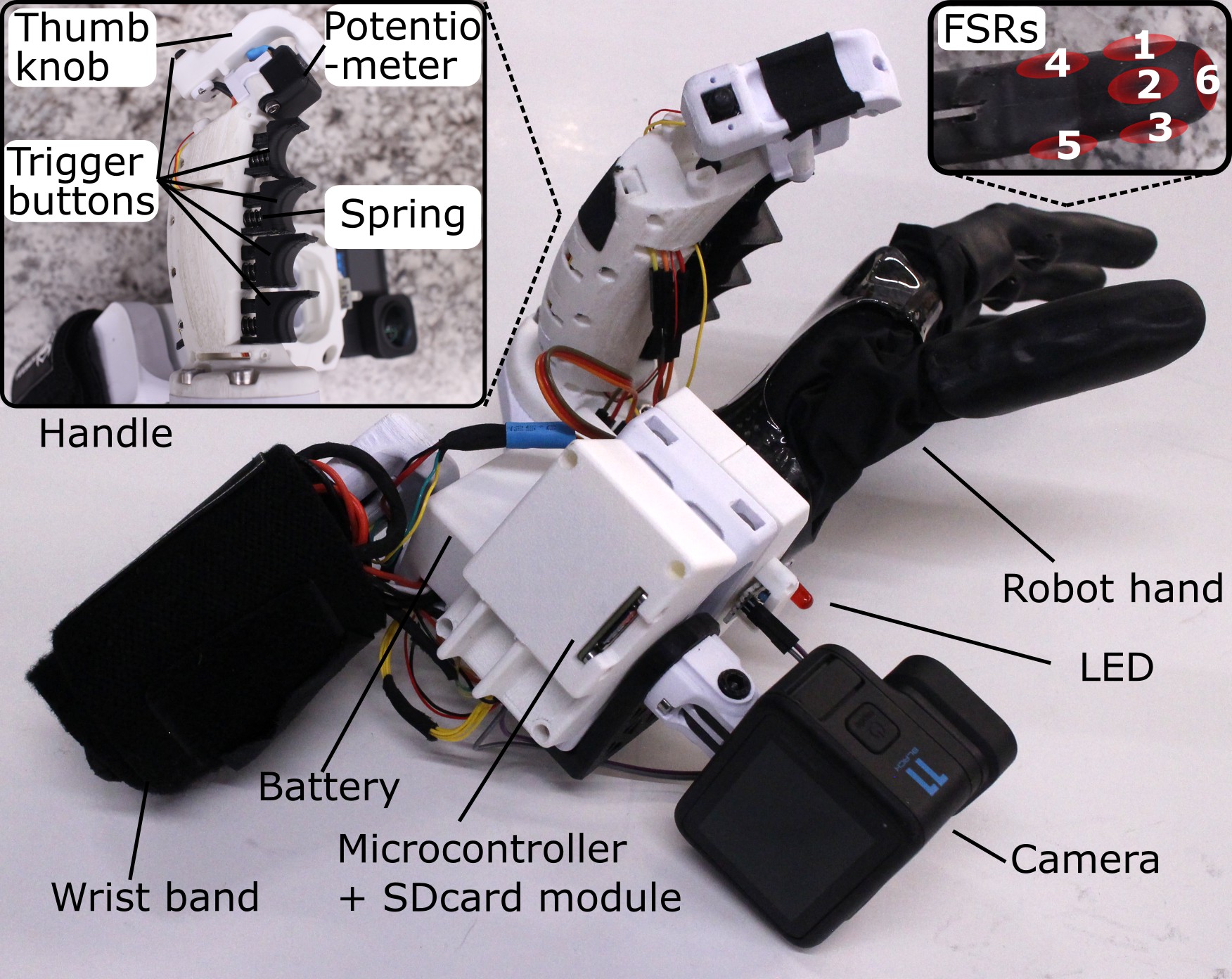
A dexterous hand, continuous finger inputs, sensing, power, and storage in one portable package.
Dexterous hardware, controller, and sensors are packaged into a handheld form.
Operators steer each finger continuously while keeping the robot hand aligned with the task.
States, touch, and scene context are captured as demonstrations unfold in the wild.
03 / Multimodal data
Capture the motion, contact, and visual context of the same manipulation sequence in one recording.
Measured motor positions and currents capture the robot hand’s internal state during interaction.
Fingertip force and pressure cues reveal when the hand grips, slips, or presses against objects.
Third-person and wrist-view observations provide environmental context for each manipulation step.
Because the data is recorded from the robot hand itself, collected demonstrations can be replayed and visualized on different embodiments while preserving the original interaction geometry.
04 / Demonstrations & replay
Three contact-rich tasks demonstrate how direct robot-hand demonstrations transfer to real execution.
Operate the robot hand in the task environment.
Synchronize motion, contact, and camera streams into one demonstration timeline.
Transfer the recorded sequence to a humanoid hand and evaluate execution quality.
Replay retains the main temporal structure of coordinated finger motion. Contact-rich actions remain challenging, which makes the data valuable for teaching robust manipulation policies.
Robust alignment and contact matching required for accurate insertion.
Sequential grasp and release behaviors capture dexterous manipulation transitions.
Stable contact control produces meaningful pressing and twisting under load.
Citation
@inproceedings{hong2026dexphd,
  title={DEX-PHD: A Dexterous Portable Handheld Device for Multimodal Data Collection},
  author={Hong, Jooyoung and Myers, Noboru and Kwon, Obin and Yang, Yixian and Kim, Joohyung},
  booktitle={Proceedings of the International Conference on Humanoid Robots},
  year={2026},
  note={arXiv:2610.35462}
}This work was partially supported by Toyota Research Institute (TRI).